
Understanding operational complexity is essential for businesses looking to scale effectively. It involves recognizing the intricacies and interdependencies within an organisation, which can often lead to inefficiencies and challenges.
As organisations grow, operational complexity increases. More people, customers, products, systems, and processes create more interactions and dependencies across it. Ways of working that were effective when the business was smaller can become increasingly difficult to manage.
The symptoms are often familiar: inconsistent performance, increasing dependence on key individuals, reduced visibility, unclear responsibilities and growing operational risk.
Management may know that something is wrong without being able to see precisely where the underlying problem lies.

ERP systems can be enhanced by prioritizing user training and feedback. Organizations should involve employees in the selection and customization of these systems to ensure they meet the actual needs of the workforce. This collaborative approach can help bridge the gap between technology and effective operational execution.
Process mapping exercises can be complemented by ongoing evaluations of their effectiveness. Regular check-ins can help teams adjust workflows as needed and ensure that documentation remains relevant. This iterative process can enhance adherence and reduce the likelihood of reverting to outdated practices.
To increase the likelihood of successful implementation of consultancy reports, organizations may consider setting up dedicated project teams. These teams can focus on executing recommendations, providing accountability and ensuring that changes are embedded within the organization’s culture.
Continuous improvement programs can be enhanced by integrating feedback loops. This allows organizations to not only optimize individual processes but also to assess how these processes fit within the broader operational framework. Such integration fosters a culture of ongoing evaluation and adaptability.
Organizations should also consider flattening their management structures to reduce complexity. By enabling faster decision-making and fostering direct communication, businesses can enhance their responsiveness to market changes and internal challenges.
Understanding the Challenges of Operational Complexity
A common cause is that the organisation’s operational structure has not developed at the same rate as the business. Processes may have evolved informally. Responsibilities may overlap, and important operational knowledge may remain with particular individuals rather than being embedded within the organisation.
As complexity increases, these weaknesses become more significant. Decisions take longer. Coordination between teams becomes harder. Management has less visibility of how work is actually being performed. Problems that could once be resolved informally begin to affect performance across the organisation.
Technology can compound the problem. Digital systems can improve efficiency and provide valuable information. However, technology does not determine how an organisation should operate. Introducing new systems into poorly understood or inconsistently applied processes can simply digitise the existing complexity.
Multiple applications can also fragment operational information. Different departments may use different systems, creating gaps between processes and making it difficult for management to understand how work flows across the organisation.
Organisational structure can create similar problems. As businesses grow, additional management layers are often introduced to maintain control. While this can provide a short-term solution, it can also increase communication paths and slow decision-making, adding further complexity.
Dependence on key individuals is another common consequence. Experienced employees frequently become the people who know how things really work. They understand the exceptions, relationships, and informal procedures that keep operations moving. This creates operational vulnerability because knowledge and decision-making become concentrated in individuals rather than embedded in systems and processes.
Businesses naturally respond to these problems. They introduce ERP systems, map processes, commission consultancy reviews, launch continuous improvement programmes or add management resources.
Each can address part of the problem. But individually they rarely address the underlying issue: whether the organisation has the operational structure required to scale.
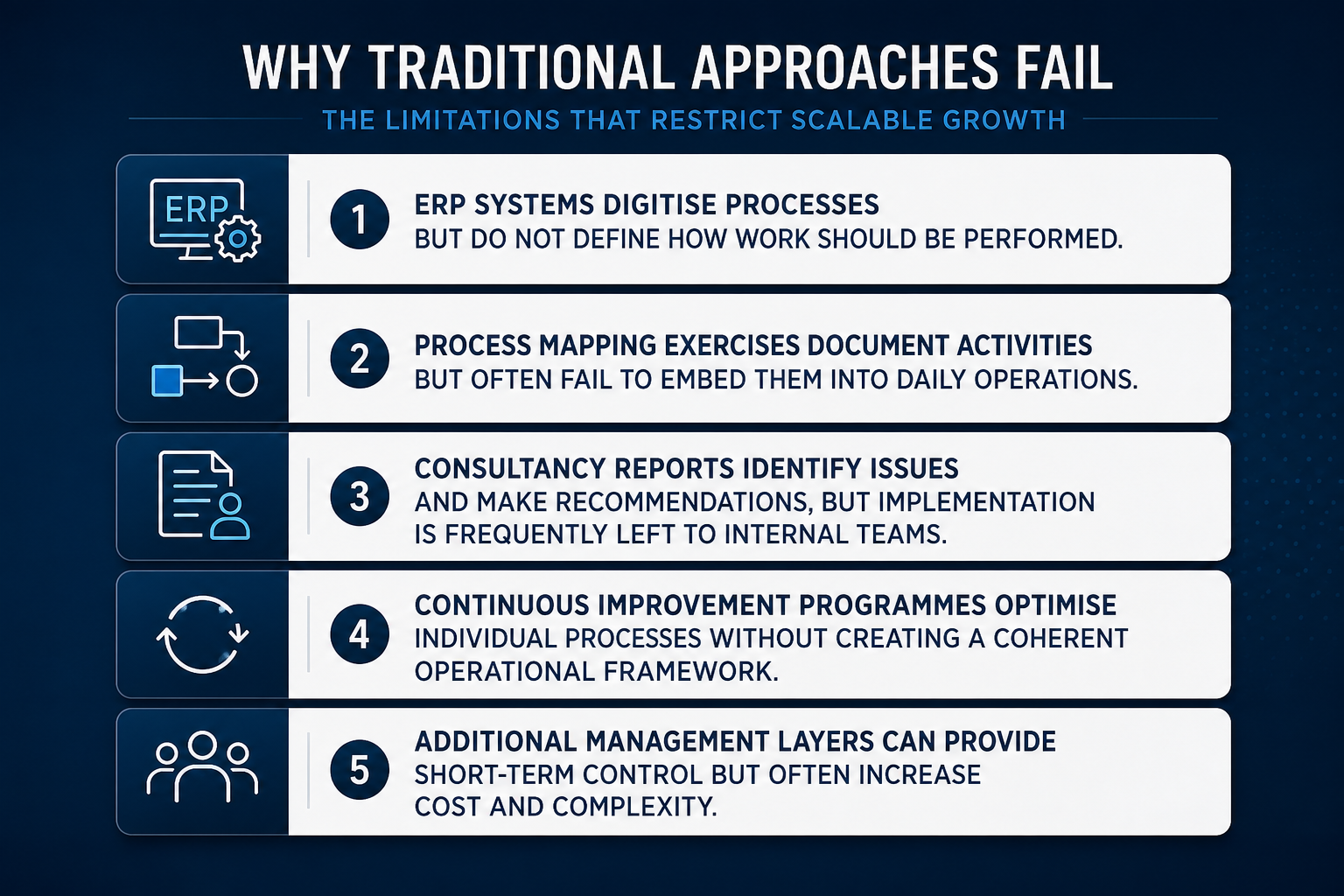
ERP systems can digitise processes without defining how work should be performed. Process mapping can document activities without ensuring those processes are embedded into everyday operations. Consultancy reports can identify problems and recommend solutions while leaving implementation to the organisation. Continuous improvement can optimise individual processes without creating a coherent operational framework. Additional management can increase control while simultaneously increasing cost and complexity.
The problem is therefore not that these approaches have no value. It is that they address different components of a wider organisational problem.
Sustainable scalability requires these components to work together. Organisational structure, processes, systems, knowledge, responsibilities, and management controls must form a coherent operating environment in which work can be performed consistently without excessive dependence on individual people.
This is the problem that Operational Scalability Methodology™ (OSM) is designed to address. Rather than examining individual processes or systems in isolation, OSM assesses how the organisation operates as a whole. It identifies the constraints limiting scalability and determines the operational improvements required to support further growth.