Growth Doesn’t Create Scalability
Growth creates complexity.
As organisations expand, customers increase, product portfolios broaden, teams grow and decision-making becomes more distributed. What once worked through direct oversight, personal knowledge and informal communication becomes increasingly difficult to manage.
Many organisations assume that growth problems can be solved by working harder, hiring more people or investing in new technology. In reality, sustainable growth depends on something far more fundamental: the ability of the organisation to scale its operations without losing control, consistency or performance.
The Operational Scalability Methodology™ (OSM) was developed to assess that ability.
What is OSM?
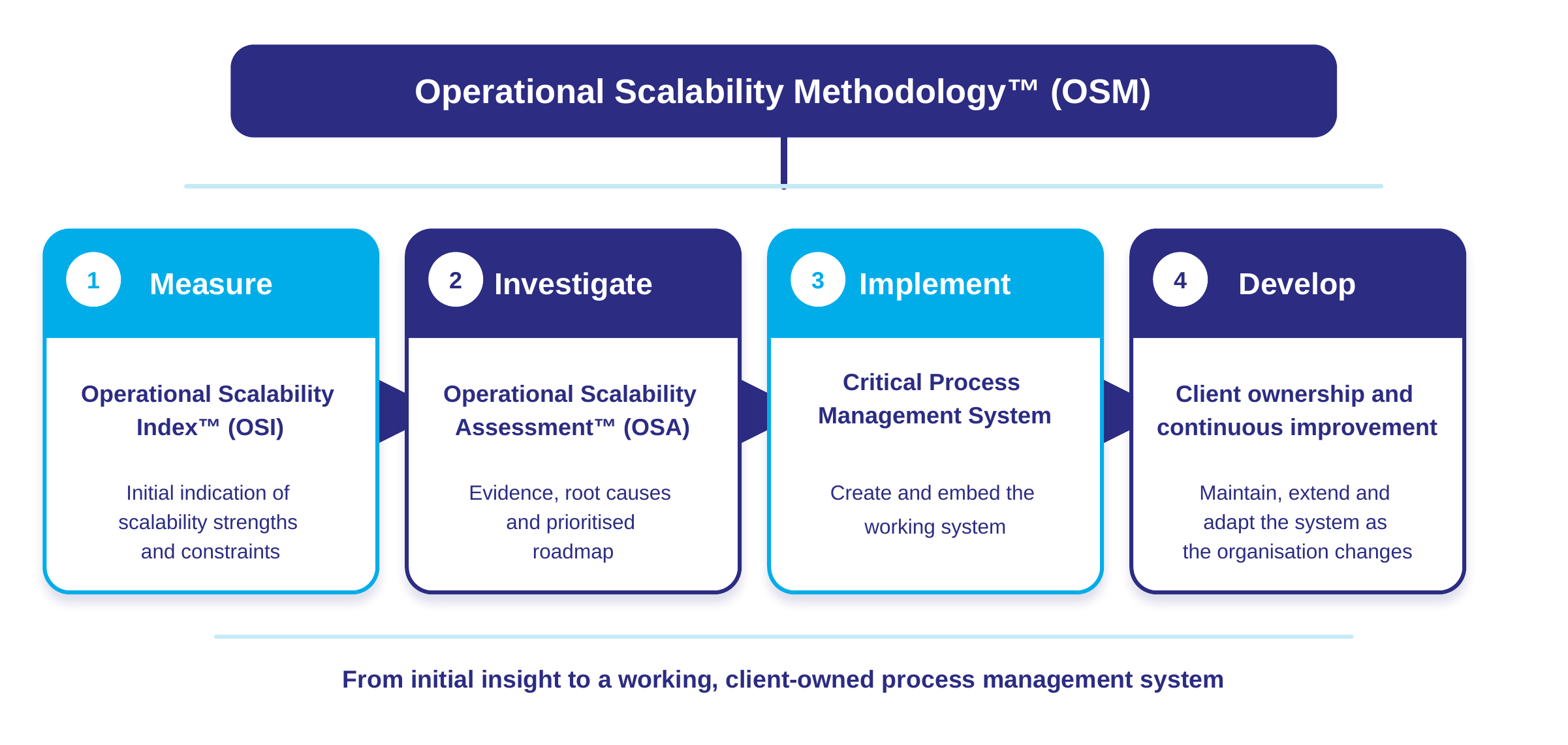
The Operational Scalability Methodology™ (OSM) is E-Squared’s four-stage method for identifying and resolving the operational constraints that prevent organisations from scaling successfully.
It provides a structured route from initial measurement and evidence-based assessment through to implementation and continuing development.
1. Operational Scalability Index™ (OSI)
A rapid self-assessment that provides an initial measure of the organisation’s scalability strengths and constraints.
2. Operational Scalability Assessment™ (OSA)
An evidence-based investigation that identifies the underlying causes of limited visibility, weak operational control and scalability constraints, and produces a prioritised roadmap.
3. Critical Process Management System Implementation
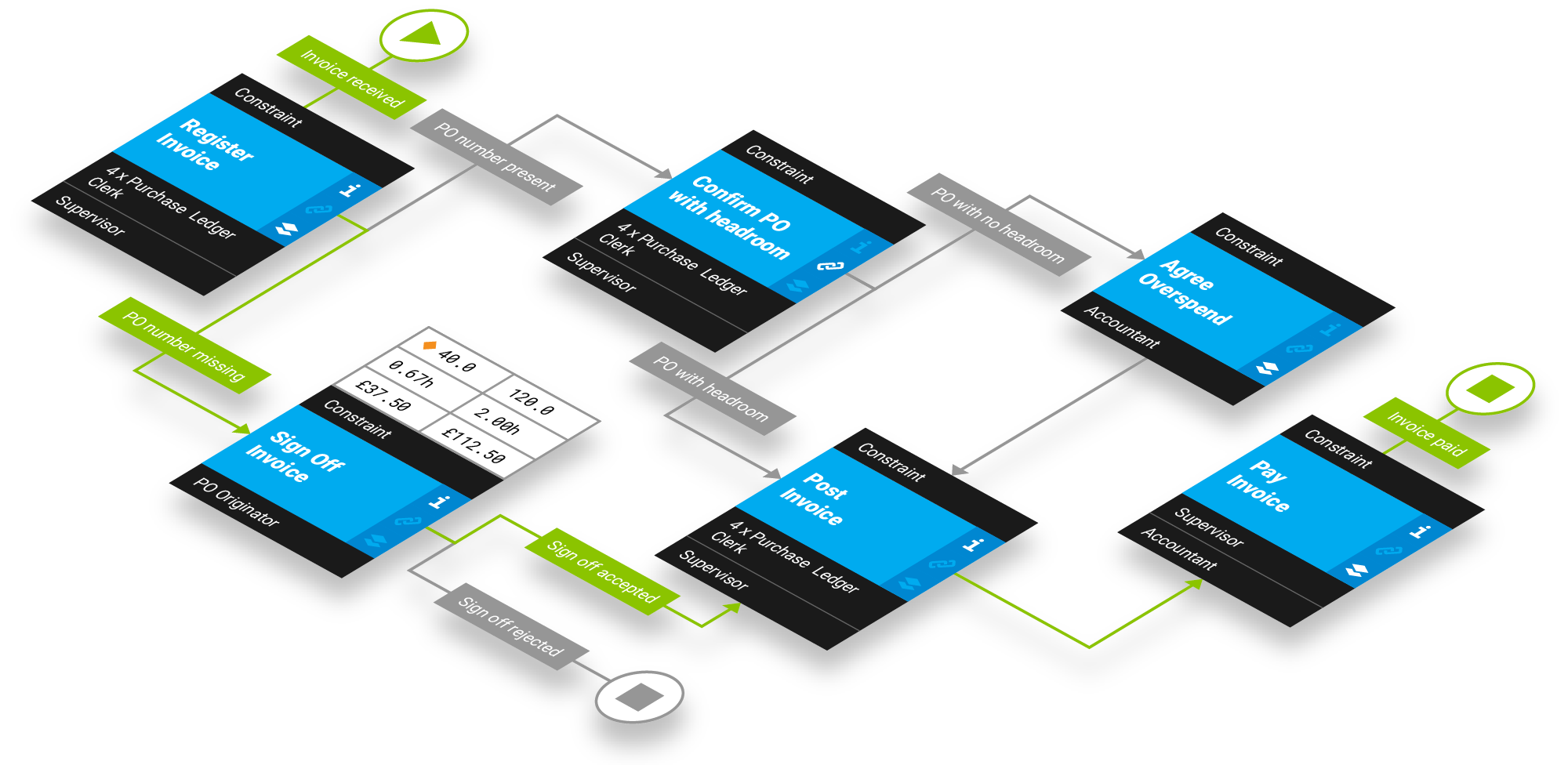
E-Squared works with the people who lead, perform and understand the critical work to create and implement the processes, responsibilities, controls and management information required to address the identified constraints.
4. Continuing Development
The organisation maintains, expands and adapts its process management system as its operations, priorities and risks change.
What we assess
The Six Dimensions of Operational Scalability
OSM evaluates the six critical dimensions of operational scalability.
These operational foundations determine whether an organisation can continue growing without losing visibility, control or performance.

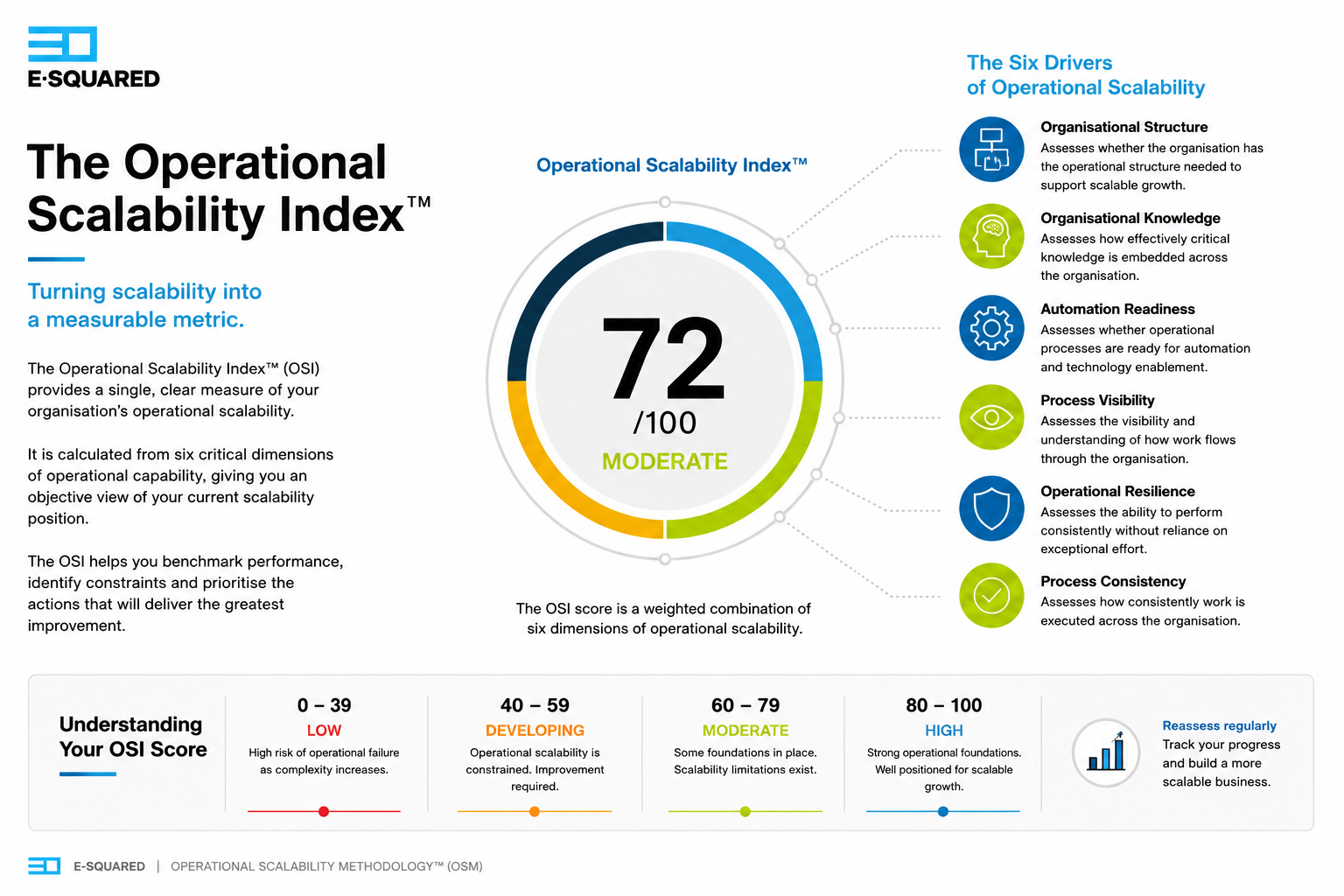
Organisational Structure
Assesses whether the organisation has the operational structure needed to support scalable growth.

Organisational Knowledge
The extent to which critical knowledge is embedded within the organisation rather than residing with individuals.

Automation Readiness
The degree to which operational processes are sufficiently defined and controlled to support automation and technology investment.
Process Visibility
The ability of management to understand how work flows through the organisation and where constraints exist.
Operational Resilience
The organisation’s ability to perform consistently without dependence on exceptional individual effort.
Process Consistency
The extent to which operational processes are defined, adopted and applied consistently across the organisation.
The Operational Scalability Index (OSI)
The metric of scalability
The Operational Scalability Index™ (OSI) is the primary output of OSM.
It provides a clear measure of an organisation’s current scalability position and highlights the operational constraints limiting future growth.
Benefits
✓ Objective measurement
✓ Identification of scalability constraints
✓ Prioritised improvement opportunities
✓ Progress tracking over time
✓ Better-informed growth decisions